What does non-manifold mean?
On a manifold triangle surface, an interior edge belongs to two faces and a boundary edge belongs to one. Three or more faces sharing an edge is a non-manifold connection. Vertices need a separate check: triangles can meet at one vertex in disconnected fans even when every edge passes the face-count test.
An open boundary is not automatically a defect. A flat patch can be a valid open surface. If you need a closed solid, use the separate Require closed surface setting and review the hole-filling guide.
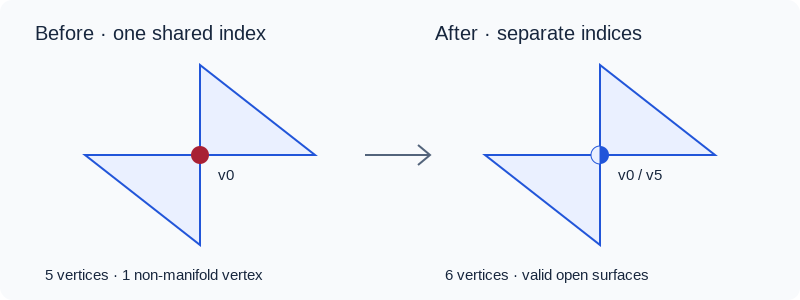
Worked example: two fans sharing one vertex
This small mesh contains two triangles touching at one vertex. The shared index creates one non-manifold vertex. Splitting it gives each triangle its own valid vertex neighborhood.
- Download the defective example (OFF), then open the workspace and select it.
- Keep Simplify mesh, Fill small holes and Require closed surface off. Keep Preserve surfaces.
-
Run repair. Open the full diagnostics and compare
nonmanifold_verticesbefore and after serialization. - Download the validated STL/PLY. The boundary remains open, as requested.
| Check | Input | Saved output |
|---|---|---|
| Faces | 2 | 2 |
| Vertices | 5 | 6 |
| Non-manifold vertices | 1 | 0 |
| Protected coincident vertices | 0 | 1 |
| Boundary edges | 6 | 6 |
Why can a valid result still contain a duplicate position?
The two fans need distinct vertex indices at the contact point. Welding those indices back together recreates the defect. MeshRepair reports this as a protected coincident vertex. It is retained deliberately and checked against the surface contract.
Exact duplicate positions are different from nearly coincident points. The pipeline does not apply an undocumented distance tolerance to weld nearby vertices. Geometry-only repair also does not preserve texture seams, colors or materials.
When automatic repair is not enough
A non-manifold edge, a crossing surface and a shared-vertex defect can require different changes. Splitting triangle indices alone does not make crossing surfaces valid. Unresolved geometric contacts, intersections or edges with too many incident faces cause validation to fail.
Use the diagnostics to identify the remaining issue. If the model consists of overlapping closed solids and a combined volume is intended, read the self-intersection and solid-union guide. Otherwise, revise the source geometry in your modeler. A failed run offers a diagnostic report, without a repaired mesh download.
Check and repair a mesh ↗Non-manifold mesh questions
Is every open mesh non-manifold?
No. A sheet with a normal boundary can be a valid manifold surface. Closedness is an additional requirement when you need a solid. See the difference between manifold and watertight.
Why can non-manifold edges remain after repair?
Separating stored vertices or cutting crossing triangles can leave several faces along the same geometric edge. Some cases require removing or rebuilding surfaces in an editor. The remaining-defects explanation describes why validation rejects them.